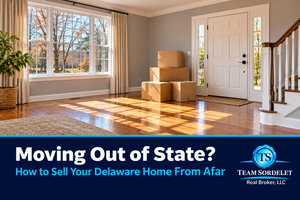
Can you sell a Delaware house after you've moved out of state?
Yes. You can sell a Delaware home after you relocate, but the plan changes once the house is empty. You'll want professional photos before you move out, a plan for keeping a vacant home safe through winter, and an early conversation with the settlement attorney about signing remotely. Nonresident sellers may face state withholding at settlement, and the federal capital gains exclusion requires that you lived in the home at least 2 of the 5 years before the sale, so the clock starts once you move.
By David Sordelet | Nov 19, 2026
A new job in another state. A move closer to the grandkids. Retirement somewhere warmer. Plenty of my sellers are already packing, or already gone, when we start talking about the house.
Selling from a distance is very doable. But a few things change when you're not there, and a couple of them have real deadlines.
Sell before you go, or after?
Selling while you still live there usually gets the best result. The house looks lived-in, you can handle small issues fast, and you're not paying for two homes.
Selling after you move is more common than people think, and it can work well. The trade-offs:
- Carrying costs. Mortgage, taxes, insurance, and utilities keep coming every month the house sits.
- Vacancy risk. An empty house in a Delaware winter needs heat, regular checks, and someone watching for leaks.
- Presentation. Empty rooms photograph smaller and feel colder.
If you need to buy in your new state first, the financing questions are the same ones you'd face selling and buying within Delaware: bridge financing, contingencies, and timing.
Do these before the moving truck comes
- Get professional photos and video while the house is furnished. Even if you won't list for a month, shoot it now. Here's how to prepare your Delaware home for listing photos.
- Complete your Seller's Disclosure. Delaware requires sellers to complete the Seller's Disclosure of Real Property Condition Report, and buyers need it before they sign an agreement of sale. You know the house best, so fill it out while you're still there.
- Consider a pre-listing inspection. When you can't run over to meet a contractor, finding problems early saves you from long-distance repair negotiations. Here's when a pre-listing inspection makes sense in Delaware.
- Gather the paperwork. Mortgage statement, HOA contacts, utility accounts, warranties, permits, and keys for everything.
- Call your insurance agent. Many homeowners policies treat a vacant home differently. Ask what your policy requires once you move out, and whether you need different coverage.
Keeping a vacant Delaware home safe in winter
- Keep the heat on at a safe setting and the utilities active for showings and inspections.
- Arrange regular check-ins — after storms, during cold snaps, and after showings.
- Know where the water shutoff is, and make sure your agent does too.
- Keep the walks clear and the exterior lights on a timer. A dark, snowy driveway tells buyers nobody's home.
- Leave a few pieces of furniture or use light staging so rooms read at the right scale.
Signing and settlement from another state
Delaware is an attorney state, so a settlement attorney handles your closing. Talk to them early about how you'll sign: in person on a trip back, by mail, or through a power of attorney. Requirements vary by attorney, lender, and situation, so don't wait until the week of settlement to ask.
Two money items to plan for:
- Nonresident withholding. Once you're no longer a Delaware resident, state withholding may apply at settlement. Here's how nonresident seller withholding works in Delaware and Maryland.
- The capital gains clock. Under IRS rules, you can generally exclude up to $250,000 of gain ($500,000 for most married couples filing jointly) if you owned and lived in the home at least 2 of the 5 years before the sale. Move out, and the clock keeps running. Wait too long to sell, and you can lose the exclusion. More in capital gains tax when selling a house in Delaware. Confirm your dates with your CPA.
What I handle when you're not here
For relocating sellers, the job is to be your eyes and ears:
- Video walkthroughs and photo updates instead of you driving back
- Coordinating inspectors, contractors, and appraisers with access
- Weekly showing and feedback reports
- Electronic signatures for the listing and offers
- Working with the settlement attorney on your signing plan
Frequently Asked Questions
Can I sell my Delaware house without being there?
Yes. Most listing and offer documents can be signed electronically, and your settlement attorney can tell you whether you can sign closing documents by mail or need a power of attorney. Start that conversation early.
Do I pay Delaware withholding if I move out of state before selling?
Nonresident sellers may be subject to Delaware withholding at settlement. Whether and how much depends on your situation, so ask your settlement attorney and CPA before you list.
How long after moving out can I sell and still avoid capital gains tax?
Under IRS rules, you generally need to have owned and lived in the home at least 2 of the 5 years before the sale to exclude up to $250,000 of gain, or $500,000 for most married couples filing jointly. The clock keeps running after you move, so confirm your dates with a CPA.
Should I leave furniture in my house when I move?
If you can, leave a few key pieces or use light staging. Empty rooms photograph smaller and can feel cold. At minimum, take professional photos while the home is still furnished.
Does a vacant house affect my homeowners insurance?
It can. Many policies treat vacant homes differently, so call your insurance agent before you move out and ask what coverage you need while the house is on the market.
The Bottom Line
You can sell your Delaware home from anywhere. The sellers who do it best take photos before they leave, protect the house while it's empty, and line up the tax and signing details early.
If you're relocating, let's do a 20-minute pre-listing walkthrough before the moving truck comes — in person or by video. Text me at (302) 613-4228. You can also request your free Home Equity Report — it'll show you your home's current value, how much equity you've built, and what's happening with prices and inventory right in your neighborhood. Get your free report at search.teamsordelet.com/seller.
Team Sordelet and David Sordelet are licensed real estate professionals, not attorneys, accountants, or financial advisors. This article is general information, not legal, tax, or financial advice. Every situation is different — consult a qualified attorney, CPA, or lender about your specific circumstances before making decisions.
About David Sordelet
Looking for a trusted real estate professional in Delaware or Maryland who can help you make smart choices? Look no further than David Sordelet, Designated Broker of Real Broker Delaware and Team Leader of Team Sordelet.
With over two decades of experience, 1,000+ successful transactions, and 200+ five-star client reviews, David is recognized as one of the region's leading real estate experts. As the Designated Broker in Delaware and a licensed agent in Maryland, he provides unmatched knowledge of Wilmington, Newark, Hockessin, Dover, Middletown, and the Maryland Eastern Shore.
David understands that in real estate, who you work with matters most. That's why he combines personalized service, clear communication, and expert negotiation with the most modern marketing strategies and cutting-edge technology to achieve exceptional results for his clients.
Whether you're a first-time homebuyer, a move-up family, an investor, or a seller looking to maximize value, David Sordelet is the proven real estate professional you can count on.
Licensed in Delaware (RB-0031238) and Maryland (5013138). Team Sordelet of Real Broker, LLC, 1400 Peoples Plaza, Suite 110, Newark, DE 19702.