How much tax is withheld when a nonresident sells a house in Delaware or Maryland?
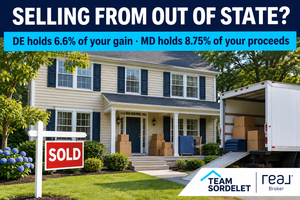
Delaware withholds 6.6% of your gain on Form REW-EST, due with the deed at the Recorder of Deeds. Maryland withholds 8.75% of your net proceeds — a completely different base — for individual sellers, on sales after June 30, 2025. Same transaction, very different hit. Maryland lets you apply to reduce it with Form MW506AE, but the application has to be in at least 21 days before closing.
By David Sordelet | November 3, 2026
If you moved out of Delaware and still own the house in Middletown, or you inherited a place in Cecil County and you live in Pennsylvania, there's a line on your settlement sheet you probably haven't planned for.
The state takes a cut of your proceeds before you ever see them.
Not the transfer tax. Not capital gains at tax time. A separate withholding, collected at the table, calculated the week of closing. I've watched sellers find out about it two days out, and that's two days too late to do anything about it in Maryland.
Here's what it actually is, how the two states calculate it very differently, and where the obvious answer is wrong.
You might be a "nonresident" even if you're a lifelong Delawarean
The word trips everyone up. People hear "nonresident withholding" and assume it's aimed at foreign investors or out-of-state landlords.
It isn't. It's about where you live on the day of settlement.
If you closed on your new place in Florida in March and you're selling the Pike Creek house in November, you're a nonresident seller. Thirty years in Delaware doesn't matter. The retiree who already moved, the adult child settling a parent's estate from another state, the couple who relocated for work and rented the old house out for two years — all nonresidents.
That last group gets caught the most. You moved, you kept the house as a rental, and now you're selling. You've been filing Delaware nonresident returns on the rent all along, so the withholding shouldn't surprise you. It almost always does.
Delaware: 6.6% of the gain
Delaware's form is REW-EST, the Real Estate Declaration of Estimated Income Tax. Longtime agents and attorneys still call it the 5403, which is what it was before the rename.
The rates:
- 6.6% for nonresident individuals and pass-through entities
- 8.7% for C corporations
What matters more than the rate is the base. Delaware applies it to your gain, not your sale price. The form walks it out:
- Total sales price, minus selling expenses, gives you the net sales price
- Net sales price, minus your adjusted basis, gives you the total gain
- Gain × 6.6% is what gets withheld
Your adjusted basis is what you paid, plus non-deductible closing costs, plus capital improvements, minus any depreciation you claimed while it was a rental. That last subtraction is the one that bites rental owners — years of depreciation deductions lower your basis, which raises your gain, which raises the withholding.
The form and the money go to the Recorder of Deeds with the deed. The deed doesn't record until it's paid.
One thing nearly everyone gets wrong: your mortgage payoff has nothing to do with it. Delaware withholds on gain. If you bought in Newark for $180,000 in 2004 and you're selling for $460,000, you have a large gain whether you owe $300,000 on the house or nothing at all. Sellers assume a big payoff shrinks the withholding. In Delaware, it doesn't move the number at all.
The exemptions are real — if you claim them
Part 5 of the form stops the calculation cold if any of these apply:
- You're a Delaware resident, or an entity not subject to net gain withholding
- The gain is exempt from capital gain recognition under a federal or Delaware exemption
- The gain is excluded from income for the year of the sale
- It's a foreclosure under 30 Del. C. § 1126(b)(3a)(3)
That third one is where the primary residence exclusion lives. If the Delaware house was your main home for two of the last five years, the federal exclusion can wipe out the taxable gain — and with no gain in income, there's nothing to withhold. The two-of-five-year window is why timing matters so much for people who moved recently and haven't sold yet. The same math that drives your capital gains tax when selling a house in Delaware drives the withholding.
Selling on an installment basis? No payment is due at settlement, but you still owe the tax as the gain is recognized federally. It's deferred, not forgiven.
And here's a detail that catches people: the form gets filed on every sale, residents included. Delaware residents complete it and check the exemption box. No withholding, but no skipping the paperwork either.
Maryland: 8.75% of your net proceeds
Cross into Cecil or Kent County and the whole structure changes.
Maryland's rates for sales after June 30, 2025:
- 8.75% for individuals, estates, and trusts
- 8.25% for business entities
The individual rate went up with Maryland's top marginal income tax rate. But the base is the real story. Maryland doesn't withhold on gain. It withholds on the total payment to the nonresident, which Form MW506NRS computes as:
Total sales price, minus selling expenses, minus mortgages and other liens secured by the property.
Read that again, because it's the opposite of Delaware. In Maryland your mortgage payoff does reduce the withholding. Your purchase price doesn't enter the calculation at all.
That inversion produces some ugly surprises.
Take a paid-off house in Elkton selling for $400,000, inherited years ago with a stepped-up basis close to current value. Real gain: small. Taxable gain after the applicable exclusions: possibly zero. But with no mortgage to subtract, the total payment is roughly the whole check — and 8.75% of it gets held.
Nothing about that is a tax bill. It's an advance on a tax you may not owe. You get it back by filing a Maryland return, which means your money sits in Annapolis until next spring.
The seller who sees this coming avoids it. The seller who doesn't, waits.
Form MW506AE and the 21-day wall
Maryland gives you a way out that Delaware doesn't: Form MW506AE, an Application for Certificate of Full or Partial Exemption.
Grounds for claiming it include:
- Principal residence under IRC § 121 — the property was your main home for two of the last five years, and you filed resident returns for that period
- Principal residence for active-duty military or certain government employees relocated on orders
- 1031 exchange handled through a qualified intermediary, with any boot stated as taxable
- Zero proceeds, where all proceeds go to another seller or co-owner
- Installment sale under IRC § 453
- Inherited property, when the transfer happens within one year of the date of death
- IRA custodian as transferor
- Transfers under specific IRC sections, and cases where tentative withholding computes to zero
The documentation is substantial — settlement statements, receipts and cancelled checks for improvements, depreciation schedules for rentals, prior returns, a letter from your qualified intermediary, a death certificate where it applies.
And the deadline is hard: the application and its documents must be received no later than 21 days before the closing date. An application with no closing date on it won't be processed at all.
Three weeks. That's the whole window. Which means the decision to pursue an exemption belongs in the listing conversation, not the week of settlement — the same way what it costs to sell a house in Delaware belongs there.
One more change worth knowing if you're selling at the high end: nonresidents selling Maryland property for $1.5 million or more can no longer apply for a tentative refund of the withholding. You file a complete annual return instead.
What this actually changes about your decisions
The withholding is almost never the real cost. It's a cash flow event — and cash flow is what trips up the sale.
Where it genuinely matters:
- You're buying your next house with these proceeds. Eight and three-quarters percent of a Cecil County check, parked with the state until you file, can break a down payment. Run that number before you write an offer, not after — and remember that whether an attorney or a title company handles your settlement differs between Delaware and Maryland, which changes who's computing this for you.
- You're inside the two-of-five-year window. The §121 clock is the single biggest lever here, in both states, and it runs whether you're watching it or not.
- You're settling an estate. Maryland's inherited-property exemption runs out one year after the date of death, which is a real deadline when heirs are still deciding. There's more on the broader process in how to sell an inherited house in Delaware.
- The house was a rental. Depreciation recapture makes your Delaware gain bigger than you expect. People consistently underestimate this one.
And the case where the obvious answer is wrong: sometimes you should just let Maryland withhold.
If your closing is 12 days out, chasing MW506AE is already impossible. If the paperwork burden is heavy and the amount is modest, the application may cost more in time and professional fees than the float is worth. Filing the return and waiting is occasionally the right call. What's never the right call is finding out at the table.
Here's what I tell every seller who's moved away or is selling a property they didn't live in: the three people who need to know your situation early are your settlement attorney, your tax preparer, and me. The attorney computes and remits it. Your tax person tells you whether you actually owe it. I make sure the question gets asked in week one instead of week eight.
Your basis documentation is the piece only you can produce. Closing statement from when you bought, receipts for the kitchen and the roof, the depreciation schedule if it was a rental. Go find those now. They're what turn an estimate into the right number.
Rates and program rules change — Maryland's individual rate moved in 2025, and the $1.5 million refund rule changed too. Verify your figures for your settlement date rather than trusting a number from a forum post or an older article.
Frequently Asked Questions
Is Delaware's nonresident withholding an extra tax I have to pay?
No. It's an estimated payment of income tax you may owe on the gain, credited against your Delaware return for that year. If too much was withheld, you file a Delaware nonresident return to get the difference back.
I lived in my Newark house for 20 years but moved to Pennsylvania last year. Am I a nonresident seller?
Yes, for this purpose — residency is measured at the sale, not by your history. The good news is that if the home was your principal residence for two of the last five years, the federal exclusion may eliminate the taxable gain, and Part 5 of Form REW-EST is where that gets claimed.
Does my mortgage payoff reduce the withholding?
In Maryland, yes — liens on the property are subtracted when computing the total payment. In Delaware, no, because the calculation is based on your gain, not on what you walk away with. It's one of the sharpest differences between the two states.
Can I get the Maryland withholding reduced after I've already closed?
Not through Form MW506AE — the application has to be received at least 21 days before closing. After settlement, your route is filing a Maryland return to claim a refund of whatever was over-withheld.
Who actually fills out these forms?
Your settlement attorney or title company prepares and remits them, and in Delaware the deed can't be recorded until the payment is made. They need your numbers to do it, though: original purchase price, capital improvements, and any depreciation claimed.
Does the Delaware form apply to residents too?
Yes. The form is completed on every conveyance of Delaware real property. Residents check the exemption box and owe no withholding, but the filing itself isn't optional.
Where to start
The withholding usually isn't your real tax bill — it's a timing problem, and a solvable one if you catch it early enough to act.
If you own property here and live somewhere else, or you're about to be in that position, the number that matters is what you actually walk away with on settlement day. That depends on your basis, your residency timing, which state the property sits in, and whether an exemption applies.
If you're curious where you stand, request your free Home Equity Report — it'll show you your home's current value, how much equity you've built, and what's happening with prices and inventory right in your neighborhood. Get your free report at search.teamsordelet.com/seller.
Team Sordelet and David Sordelet are licensed real estate professionals, not attorneys, accountants, or financial advisors. This article is general information, not legal, tax, or financial advice. Every situation is different — consult a qualified attorney, CPA, or lender about your specific circumstances before making decisions.
About David Sordelet
Looking for a trusted real estate professional in Delaware or Maryland who can help you make smart choices? Look no further than David Sordelet, Designated Broker of Real Broker Delaware and Team Leader of Team Sordelet.
With over two decades of experience, 1,000+ successful transactions, and 200+ five-star client reviews, David is recognized as one of the region's leading real estate experts. As the Designated Broker in Delaware and a licensed agent in Maryland, he provides unmatched knowledge of Wilmington, Newark, Hockessin, Dover, Middletown, and the Maryland Eastern Shore.
David understands that in real estate, who you work with matters most. That's why he combines personalized service, clear communication, and expert negotiation with the most modern marketing strategies and cutting-edge technology to achieve exceptional results for his clients.
Whether you're a first-time homebuyer, a move-up family, an investor, or a seller looking to maximize value, David Sordelet is the proven real estate professional you can count on.
License: RB-0031238-DE / 5013138-MD