Should you lock your mortgage rate now when buying a home in Delaware?
If you're under contract and the payment works at today's rate, locking usually makes sense. A lock protects you from increases as long as you close within the lock period and nothing changes in your application. Freddie Mac's 30-year average fell to 7.11% on November 12, 2026, the fourth straight weekly drop, but rates can reverse quickly. The bigger risks for Delaware buyers are a lock that's too short for the settlement date and changes like a new credit account or a low appraisal that can reprice a locked loan.
By David Sordelet | Nov 18, 2026
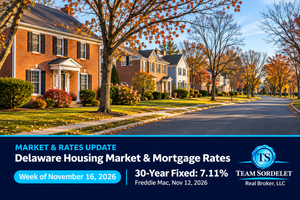
Rates have fallen four weeks in a row. Freddie Mac's 30-year average was 7.11% on November 12, down from 7.18% the week before. If you're about to make an offer, or you just got one accepted, the question is obvious: lock now, or wait for lower?
Here's how I talk buyers through it.
What a rate lock actually does
The Consumer Financial Protection Bureau describes a rate lock this way: your interest rate won't change between the offer and closing, as long as you close within the lock period and nothing changes in your application.
Both conditions matter.
- Lock periods are typically 30, 45, or 60 days, according to the CFPB, and sometimes longer.
- Extending a lock can be expensive if your closing runs late.
- A lock can keep you from a lower rate if rates fall after you lock, unless your lender offers a float-down option. Not all do, and terms vary, so ask before you lock, not after.
Check the top of page 1 of your Loan Estimate. It shows whether your rate is locked and when the lock expires. The CFPB notes that some lenders lock when they issue the Loan Estimate and some don't, so don't assume.
What can change a "locked" rate
This is the part buyers don't hear enough. Per the CFPB, your rate can still change if:
- You change your loan type or your down payment
- The appraisal comes in higher or lower than expected
- Your credit score changes — for example, because you opened a new card or financed furniture before closing
- Your lender can't document overtime, bonus, or other income
The appraisal one deserves attention. If the value comes in short, your loan amount or down payment may change, and so can your pricing. Here's what happens when an appraisal comes in low in Delaware.
And please: no new credit, no new car, no financed couch until after settlement.
How long a lock do you need in Delaware?
Your lock has to cover your settlement date, not just your target date. In Delaware, that means leaving room for:
- Inspection and repair negotiations
- Appraisal scheduling
- Title work and the settlement attorney's schedule — Delaware is an attorney state
- Septic, well, or other inspections in parts of Kent, Sussex, and rural New Castle County
Here's a realistic look at how long closing takes in Delaware.
The holiday factor: If you're closing in late November or December, Thanksgiving week and the Christmas-to-New Year stretch compress everyone's calendar — lenders, appraisers, attorneys, and recorders. If your target date is close to the end of a lock period, ask about the cost of the next-longer lock now. It's usually cheaper than an extension later.
Lock or float? How to decide
Nobody can tell you where rates go next week. What you can control is how much risk you take.
Lean toward locking when:
- You're under contract and the payment works at today's rate
- Your budget is tight, so a small rise would hurt
- Your settlement date fits inside a standard lock period
Floating may make sense when:
- You're 60+ days from settlement, such as on new construction
- You have room in your budget if rates rise
- Your lender offers a float-down you understand and can afford
Put the stakes in dollars. On a $350,000 30-year loan, a quarter-point is worth about $59 a month in principal and interest — roughly $4,900 over seven years. That's real money. But the risk runs both ways. The Fed held rates in October with two members voting to raise them, and recent headlines have pointed to inflation concerns heading into the Fed's December meeting.
Waiting for "the bottom" is a guess. A lock is a decision.
Don't forget cash to close
Your rate gets the attention, but your cash at settlement is often what makes or breaks a deal. Delaware buyers typically pay half of the 4% realty transfer tax, plus lender, title, and prepaid costs. Here's the full breakdown of buyer closing costs in Delaware. If you're using state assistance, see what DSHA down payment assistance really costs.
Frequently Asked Questions
How long does a mortgage rate lock last?
According to the CFPB, rate locks are typically available for 30, 45, or 60 days, and sometimes longer. Your lock needs to cover your actual settlement date, and extending an expired lock can be expensive.
Can my rate change after I lock it?
Yes, if something in your application changes. The CFPB lists changes in loan type or down payment, an appraisal that comes in higher or lower than expected, a credit score change, and income your lender can't document.
What happens if rates drop after I lock?
Usually you keep your locked rate. Some lenders offer a float-down option that lets you lower it once if rates fall enough, but availability, costs, and conditions vary, so ask before you lock.
Where do I see if my rate is locked?
The top of page 1 of your Loan Estimate shows whether your rate is locked and when the lock expires. Some lenders lock when they issue the Loan Estimate and some don't.
Should I lock before Thanksgiving if I'm closing in December?
If you're under contract and the payment works, many buyers do. Holiday weeks can slow appraisals, underwriting, and settlement scheduling, so choose a lock long enough to absorb a short delay.
The Bottom Line
A rate lock protects you only if it covers your settlement date and your application stays the same. Pick the right length, keep your credit untouched, and you take one big variable off the table.
Before you write an offer, let's spend 20 minutes mapping your lock window against a realistic Delaware settlement date, so the lock you choose actually covers you. Text me at (302) 613-4228. And if you own a home now, request your free Home Equity Report — it'll show you your home's current value, how much equity you've built, and what's happening with prices and inventory right in your neighborhood. Get your free report at search.teamsordelet.com/seller.
Team Sordelet and David Sordelet are licensed real estate professionals, not attorneys, accountants, or financial advisors. This article is general information, not legal, tax, or financial advice. Every situation is different — consult a qualified attorney, CPA, or lender about your specific circumstances before making decisions.
About David Sordelet
Looking for a trusted real estate professional in Delaware or Maryland who can help you make smart choices? Look no further than David Sordelet, Designated Broker of Real Broker Delaware and Team Leader of Team Sordelet.
With over two decades of experience, 1,000+ successful transactions, and 200+ five-star client reviews, David is recognized as one of the region's leading real estate experts. As the Designated Broker in Delaware and a licensed agent in Maryland, he provides unmatched knowledge of Wilmington, Newark, Hockessin, Dover, Middletown, and the Maryland Eastern Shore.
David understands that in real estate, who you work with matters most. That's why he combines personalized service, clear communication, and expert negotiation with the most modern marketing strategies and cutting-edge technology to achieve exceptional results for his clients.
Whether you're a first-time homebuyer, a move-up family, an investor, or a seller looking to maximize value, David Sordelet is the proven real estate professional you can count on.
Licensed in Delaware (RB-0031238) and Maryland (5013138). Team Sordelet of Real Broker, LLC, 1400 Peoples Plaza, Suite 110, Newark, DE 19702.