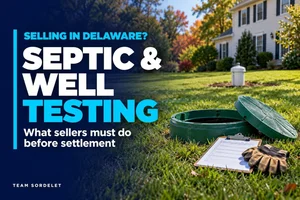
Do you need a septic inspection or well test to sell a house in Delaware?
Yes for septic, usually for wells. Delaware's DNREC septic regulations require a Class H inspection by a DNREC-licensed inspector before a home served by a septic system changes hands. The tank is pumped as part of that inspection, and a standard system typically runs about $850 to $1,000. Delaware has no state law requiring a well water test at sale. Most buyers and many lenders still ask for one, so plan on it.
By David Sordelet | October 19, 2026
If your house isn't on public sewer, the septic system is part of the sale whether you think about it or not. I'd rather you think about it before the buyer's inspector does.
Most of the septic surprises I see come from timing, not from the system itself. A seller assumes it's the buyer's problem, the inspection gets booked two weeks before settlement, and a cracked baffle or a tired drainfield turns into a scramble for permits, contractors, and a closing-date extension.
Here's how septic and well testing works when you sell in Delaware, what it costs, and how to keep it from derailing your settlement.
The Class H septic inspection: what Delaware requires
Delaware has more than 70,000 septic systems, and they're common anywhere outside a sewer service area. That includes rural southern New Castle County around Middletown, Odessa, and Townsend, much of Kent County, and large parts of Sussex.
Since DNREC updated its on-site wastewater regulations in January 2014, a septic system has to be inspected before the property transfers. Here's what that involves:
A Class H inspector does it. That's a DNREC license category specifically for system inspections. A general home inspector can't sign off on it.
The tank gets pumped. The inspector needs to see the inside of an empty tank, so pumping by a licensed pumper happens at the same visit.
The whole system gets checked. Tank structure, inlet and outlet baffles, sludge and scum levels, the distribution box, pumps and alarms if you have them, and the drainfield, usually with a flow test.
The report goes on record with DNREC. Anyone can look up past Class H reports by owner, address, or parcel number on DNREC's septic inspection lookup, and that includes your buyer.
It's also one of the few requirements that lines up with what lenders want anyway. DNREC itself has pointed out that most mortgage lenders already require a septic inspection before closing.
What it costs
For a standard gravity system with a permit on file, expect roughly $850 to $1,000, pumping included. One Delaware contractor publishes $850 to $995 for a real estate Class H inspection.
Plan on more if you have an alternative system, such as a pressure-dosed, mound, or peat system, or if DNREC has no permit on record for your system. Some inspectors bill those on a time-and-materials basis.
Next to your other selling costs, that's a small line item. A failed system you find out about late is not.
If you have a holding tank
Homes served by a holding tank have an extra step. Under DNREC's rules, the buyer must sign an Affidavit of Understanding before the purchase, and it gets filed with the permit. Flag this early so it doesn't surprise anyone at the settlement table.
What happens if the septic fails inspection
A failed inspection doesn't automatically kill a deal, but it does change the conversation. These are the findings I see most often:
Damaged or missing baffles. This is the most common finding, and it's usually a relatively modest repair.
A cracked tank or broken lines. These are mid-range repairs that may need a permit.
A failing drainfield. This is the big one. Replacing a drainfield or the whole system requires a DNREC permit, a designer, and a licensed installer, and it can run into five figures.
Repairs and replacements that come out of a Class H inspection go through the normal DNREC permit process. They aren't treated as emergency repairs, and that's why timing matters so much.
From there, you and the buyer usually land on one of three paths:
You make the repair before settlement, and the system is re-inspected.
You give the buyer a credit or price reduction and they handle the repair, if their lender allows it.
You agree in writing on a repair plan, sometimes with money held in escrow at settlement.
If you're facing a full replacement and money is tight, ask DNREC about its Septic Rehabilitation Grant Program, which helps fund replacing failing septic systems and cesspools. Eligibility rules apply, so check before you count on it.
Who pays for the septic inspection?
It's negotiable, and it's spelled out in your agreement of sale. My advice to sellers is simple: order it yourself, before you list.
Here's why. If you know the system is healthy, you have a clean report to hand buyers on day one. If it isn't, you find out while you still control the timeline and the repair choices, instead of negotiating against a deadline. It's the same logic as getting ahead of a low appraisal: the problems that hurt you are the ones you find out about last.
Anything you already know about the system also belongs on your Seller's Disclosure, whether or not you order an inspection.
Well water testing when you sell
Wells are different. Delaware doesn't have a law like New Jersey's Private Well Testing Act. A 2011 proposal would have required a water test at every sale, but today there's no statewide requirement to test a private well when you sell.
In practice, though, the test usually happens anyway:
Buyers ask for it. Most buyers' inspection contingencies include a water test, and a well with no test results is a red flag to a careful buyer.
Lenders often require it. Government-backed loans like FHA and VA commonly require water testing for homes on private wells, and some conventional lenders do too.
Some results need treatment. Bacteria such as coliform and E. coli, nitrates, iron, manganese, and in coastal Sussex, salinity are the usual concerns.
A basic test for bacteria and nitrates is inexpensive compared with almost anything else in a sale. The Delaware Division of Public Health also offers free bacteria and chemistry test kits for primary residences, available at its offices in Newark, Smyrna, Dover, and Georgetown. For a transaction, ask the buyer's lender which lab and which tests they'll accept before you pay for one.
If a test comes back positive for bacteria, it's often fixable with shock chlorination and a retest, or a treatment system. Again, it's far better to learn that two months before settlement than two days before.
A seller's septic and well timeline
This is the sequence I walk my clients through:
Before you list: Pull up your past Class H reports on DNREC's lookup, find your permit, and locate the tank lids.
Two to four weeks before listing: Schedule the Class H inspection and pumping, and the well test if you have one. Spring and summer calendars fill fast.
If something fails: Get repair quotes and talk with your agent about whether to fix it now or price it in.
At listing: Put the reports in the disclosure package so buyers see them before they make an offer.
Under contract: Expect the buyer's lender or inspector to ask questions, and answer them with paperwork, not promises.
Done this way, septic and well testing becomes one more box you've already checked when your closing timeline starts running.
Frequently Asked Questions
Is a septic inspection required to sell a house in Delaware?
Yes. DNREC's on-site wastewater regulations call for a Class H inspection by a DNREC-licensed inspector before a property served by a septic system is transferred. Most mortgage lenders require one as well.
How much does a Class H septic inspection cost in Delaware?
For a standard system with a permit on file, expect roughly $850 to $1,000 including pumping. Alternative systems, or systems with no DNREC permit on record, usually cost more.
Who pays for the septic inspection when selling a house in Delaware?
It's negotiated in the agreement of sale. Many sellers choose to order and pay for it before listing so they control the timing and can hand buyers a clean report up front.
Do you have to test well water when selling a house in Delaware?
Delaware has no statewide law requiring a well test at sale. Most buyers request one during inspections, and FHA, VA, and some conventional lenders commonly require water testing for homes on private wells.
What happens if a septic system fails inspection during a sale?
The seller and buyer negotiate a repair, a credit, or a price reduction. Repairs go through DNREC's normal permit process, so a failing drainfield found late can delay settlement.
The bottom line: in Delaware, the septic inspection is required, the well test is expected, and the sellers who do both before they list are the ones who settle on time.
If your home is on septic or a well, I'm glad to walk you through what your system means for your sale before you put a sign in the yard. And if you're curious where you stand, request your free Home Equity Report. It'll show you your home's current value, how much equity you've built, and what's happening with prices and inventory right in your neighborhood. Get your free report at search.teamsordelet.com/seller.
About David Sordelet
Looking for a trusted real estate professional in Delaware or Maryland who can help you make smart choices? Look no further than David Sordelet, Designated Broker of Real Broker Delaware and Team Leader of Team Sordelet.
With over two decades of experience, 1,000+ successful transactions, and 200+ five-star client reviews, David is recognized as one of the region's leading real estate experts. Licensed as the Designated Broker in Delaware and an Agent in Maryland, he provides unmatched knowledge of Wilmington, Newark, Hockessin, Dover, Middletown, and the Maryland Eastern Shore.
David understands that in real estate, who you work with matters most. That's why he combines personalized service, clear communication, and expert negotiation with the most modern marketing strategies and cutting-edge technology to achieve exceptional results for his clients.
Whether you're a first-time homebuyer, a move-up family, an investor, or a seller looking to maximize value, David Sordelet is the proven real estate professional you can count on.
License: RB-0031238-DE / 5013138-MD
Team Sordelet and David Sordelet are licensed real estate professionals, not attorneys, accountants, or financial advisors. This article is general information, not legal, tax, or financial advice. Every situation is different — consult a qualified attorney, CPA, or lender about your specific circumstances before making decisions.
Hello, World!